Despite newspapers being disposable, ephemeral commodities, they are often found in home archives. As records of important historic events and smaller personal events like weddings, births, and deaths, newspapers are worth saving. This article is going to discuss how to properly store newspapers and clippings that you want to save. Nothing lasts forever, and newsprint is likely the first to go, but there are things you can do to slow down its deterioration.
Pro Tip: When working with your newspapers and clippings make sure your hands are clean and dry and do not have any lotions on them. Wearing gloves is more likely to cause damage to fragile paper.
TLDR
The best way to prolong the life of newspapers is to protect them from sunlight, heat, and humidity, stored unfolded in a buffered, acid-free, lignin-free box. See our Newspaper and Magazine Kits. Our YouTube channel has a video on this topic – How to Safely Store Old Newspapers & Magazines in Archival Boxes
- Skip to How to Store Newspaper Clippings
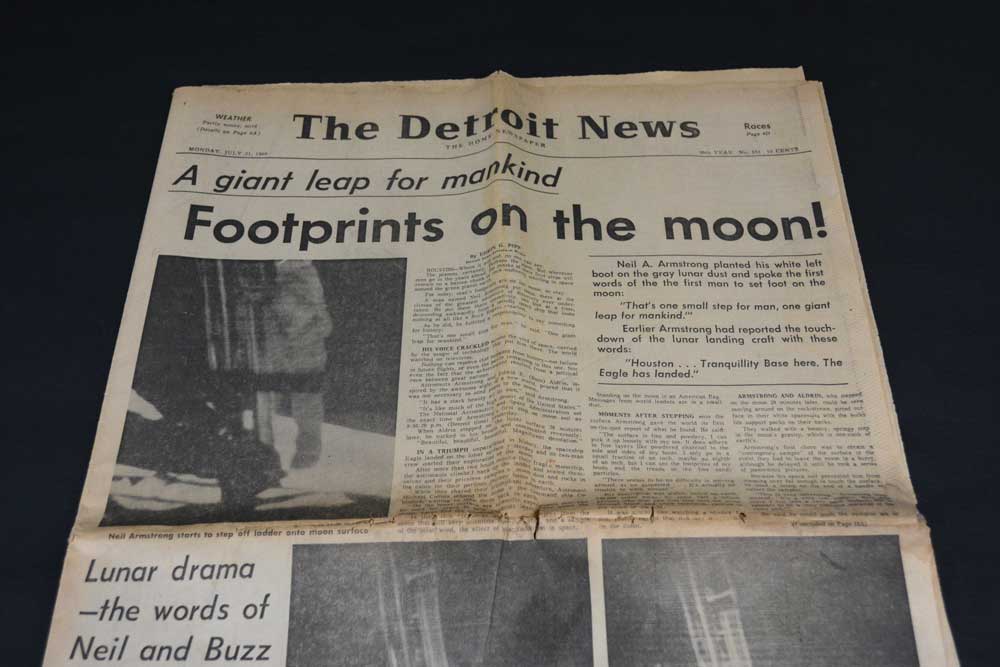
Someone thought to save this newspaper about the momentous moon landing on July 21, 1969. But the 50 plus years since have not been kind to this Detroit paper because:
- acids and lignins are not removed from cheaply produced newsprint
- storage conditions were less than ideal – it was probably stored in a basement with high temperature and humidity fluctuations
- it was stored folded twice – in half and then in half again
- it was likely stored in an acidic box or in the open on a shelf exposed to air, light, and humidity

Some Tips from the Northeast Document Conservation Center
Newspapers are designed to be read and discarded on a daily or weekly basis. They are printed on a non-archival, inexpensive, wood pulp paper called newsprint. Newsprint is manufactured cheaply without removing the lignins present in the wood pulp, which makes the paper become brittle and yellow over time and is accelerated by exposure to air, sunlight, and humidity.
Therefore, the best way to prolong the life of newspapers is to protect them from sunlight, heat, and humidity. The NEDCC takes a realistic view when it comes to preserving newsprint (see Section 4). They view the value in the content rather than the artifact and their advice is to make high quality copies using archival paper and deaccession (get rid of, in museum speak) the originals. And that is certainly one option, especially for a large archive with limited space and resources. But some people really like save the original artifact.
NEDCC also mentioned treating the paper by deacidification, which means removing the acids from the paper. But if it is already yellowed and brittle, this cannot be reversed. If interested in pursuing this you will need to find a conservator.
Another important takeaway from their brief discussion of newsprint is, when keeping it, separate it and store in buffered materials. You should separate newsprint by putting it in an enclosure so that it doesn’t come in contact with other items it is stored with, including other clippings. NEDCC recommends using a Polyester Sleeve and we offer several other good options as well.
Why an Archival Buffered Box is Important
Newsprint has high acid and lignin content and the acid-free, lignin-free, buffered box helps to counteract these acids. Buffered materials add an extra level of acid-fighting properties to your storage environment. Calcium carbonate is added to the board and paper to make it more alkaline and this helps scavenges acids within the box. We make all of our boxes, binders, and portfolios with buffered materials. And we have a selection of buffered and unbuffered acid-free, lignin-free, archival paper, tissue, and card stock.

Newspaper and Magazine Storage Kits
Our Newspaper and Magazine Storage Kits come with or without a desiccant for humidity control. All of them include:
- One acid-free, buffered 3″ Metal Edge Drop Front Box
- Ten archival Polyethylene Bags
- One Adhesive Back Vinyl Label Holder (3-3/4 x 1-3/4” H)

These kits are designed to store whole newspapers (we will discuss how to store news clippings later in the post). Some people ask us if each page needs to be stored in its own bag. No. You can store an edition or whole paper or section in one bag. And multiple papers can go into one box. Just don’t overfill the box.

Store the box on a closet shelf in your living space. Attics and basements are never good choices for longterm archival storage. See our blog post about Agents of Deterioration to find out more.
How to Choose the Right Kit
Measure the newspaper or papers that you want to store. If you have room to store the newspaper unfolded (like the Detroit News seen above) then unfold it along the horizontal center seam and measure the width and length. The box measurements that we list on our website are for the interior dimensions. Then measure the height of the stack of newspapers. The kits have a 3″ depth. And the poly bags will add some bulk.
Broadsheets (the size once used by reputable newspapers) can vary in dimensions by the newspaper, the date, and the country. Some will fit unfolded into our 20 x 24 Newspaper and Magazine Storage Kit. Older newspapers might be even larger than this. The box should be stored flat.
To Fold or Not to Fold
When it comes to papers and textiles the fewer folds the better. Paper and fabric weaken and deteriorate more quickly along folds because there is more stress on the fibers. There are times when you can’t store something unfolded because of size or budget considerations. Note, we are not talking about the vertical fold (the gutter) that separates the pages. You can leave that folded.

Newspaper & Magazine Kits go up to 20-1/2 x 24-1/2 x 3″ deep but we have two metal edge boxes that are larger if you need something bigger. Our largest Drop Front Box is 22-1/2 x 28-1/2 x 2″ deep (item 01-542) and it is listed with the 3″ Drop Front Boxes. Our largest metal edge box is a Full Top Box 24-1/4 x 32-1/2 x 1-1/2″ deep (04-532). We sell Poly Bags in packages of either one hundred or ten in sizes up to 22 x 28. If you need to get the 24 x 32 box you could use our buffered Archival Paper as interleaving between the different newspapers. We also have Crystal Clear Bags in 24 x 30 and 24 x 36 sizes.
How to Store Just One Newspaper
Our Newspaper and Magazine Kits all feature the 3″ deep drop front metal edge box. If you only have one or two newspapers that you want to store you can get a shallower box, such as the two over-sized ones mentioned above. And for smaller dimensions you could opt for the 1-1/2″ Deep Drop Front Box.

What is a Desiccant

Desiccants reduce humidity inside your archival storage boxes to help protect your archives. Include a desiccant to absorb and contain water vapor to help maintain a safe relative humidity for your collections. If your home is air conditioned and the air is never humid inside then you could probably skip the desiccant. But if the air in your home is humid then a desiccant is a good idea. You can get a hygrometer to monitor the relative humidity in your home. Aim for it to be between 35 – 55%.

The Newspaper & Magazine Storage Kit with Desiccant gives you a choice of a metal or cloth rechargeable desiccant for your box. The desiccants are filled with non-toxic silica beads that absorb water within a small space (the box). When the beads become saturated, the moisture can be removed with heat and the desiccant can be used again.
You need to periodically inspect your boxes and see if the desiccant needs to be recharged. The metal one must be recharged (dried out) in an oven whereas the cloth one can be done in a microwave. Here are the instructions to recharge them, which are also posted on the product page under Resources.
Buffered Interleaving and Support
Some people ask if they should interleave the pages of the newspaper. You don’t need to but buffered interleaving would help absorb more acids. Just make sure you don’t stress the center fold with too much bulk. If you decide to do this we recommend using Buffered Archival Tissue. The buffering will help absorb acids that are in the newspaper. Tissue is very thin so it will add the least amount of bulk.
Another thing you could use in conjunction with or instead of the Polyethylene Bags is White Card Stock or 2-Ply Conservation Mat Board. You could put each individual newspaper between the card stock. Or, you could calculate the size card stock you would need to make a large folder. When placing an order for board or paper you can request at checkout that we cut it down to a custom size, if needed. Or, you could insert a piece of card stock under your newspaper within the poly bag as additional support.
How to Make a Digital Back-Up Before Storing
A normal flatbed scanner might not work on a large newspaper or it might be too risky to try if your newspaper is already in rough shape. Camera scanning would be better (which is using a camera instead of a scanner to capture your artifacts). If you aren’t able to set this up you could hire a professional.
I gave a talk at our local library and one of the attendees recommended the free Adobe Scan app for phones. If you don’t have a copy stand, which most people don’t, we recommend you find a well-lit room on a sunny day, lay down a clean sheet to set the newspaper on, and then use your phone to photograph the paper. Avoid casting your shadow into the image. If you use the Adobe Scan app it will create a searchable PDF for you.
How to Store Newspaper Clippings
News clippings are another common item found in family archives. Engagement, wedding, birth, and death announcements were often published in local newspapers and then cut out and saved. Due to their high acidity you should isolate them inside enclosures.


Use Card Stock Inserts as Backing Boards
Using Card Stock Inserts as support inside of your enclosure is beneficial for several reasons. It adds rigidity and supports the fragile paper during storage and handling. Our archival Card Stock is buffered with calcium carbonate so it absorbs acids from the news print. And it provides space to write information regarding the article, including why you saved it, and the name of the paper and the date it was published if you have that information. Remember to use a #2 pencil or archival pen.

The Side Loading Sleeve shown above protects the newsprint but allows you to still read both sides without removing it from it’s sleeve.

News print inside sleeves can then go into a Metal Edge Drop Front Box or an Archival Folder inside a Document Box. An Archival Binder with Archival Binder Pages would be another option. For more info please see How to Store Old Letters and Documents.
